The Hundreds wants to sell but not sell out The street-wear brand has stores in L.A. and San Francisco, a strong online presence and a solid buzz. But its clothes are aimed at skater and hip-hop subcultures, which loathe overexposure. By Nathan Olivarez-Giles
May 26, 2009
When the founders of the L.A. clothing brand the Hundreds first met, they were unhappy law school students looking for a way out.
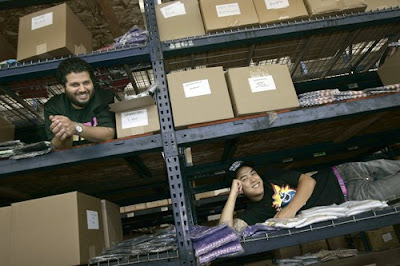
Six years after they started designing T-shirts to ease the boredom they felt in class, 29-year-old Bobby Kim and Ben Shenassafar are running a humming business, complete with a website, blog and their own mini-subculture out of a storefront in the Fairfax District and a warehouse near downtown.
With a second store in San Francisco and a growing buzz about their products, the pair are now confronting a classic small-business dilemma: They want to expand, and experts say they should. But they don't want to lose the hip edge that made them popular in the first place.
The Hundreds employs 30 people and sells logo T-shirts, shoes, shorts and accessories including mouse pads and wallets. The brand is a part of a fashion movement known as street wear, which typically consists of casual clothing aimed at quasi-underground subcultures such as skaters and hip-hop fans.
The company's strategy shows how word of mouth combined with a strong -- and edgy -- online presence can lead to success, especially when the target audience is young adults and teenagers.
Key to the viral nature of its marketing is the Hundreds' blog, at thehundreds.com, which Kim and Shenassafar started when the clothing line launched in 2003.
The idea, Kim said, was to create a way for young customers to feel connected to the company.
"We said, let's have it so the kids interact with us and they feel as much a part of it as we do," he said.
Updated daily by Kim, the website recently registered 1.8 million monthly page views, according to traffic-measuring site Quantcast.com.
The Hundreds shop is one of a cluster of street-wear stores to open around Fairfax Avenue, helping produce a small renaissance in the district's faded commercial area. Street-wear boutique Brooklyn Projects, near Melrose and Fairfax avenues, was the first to open in 2002.
In 2004, the New York brand Supreme arrived, followed by the Hundreds' first store in 2007. When John Earle wanted to open a West Coast store last year for his Boston brand Johnny Cupcakes, the Fairfax District was the first place he looked.
"We're making it a destination spot with these other brands popping up around there," Earle said.
On the blog, Kim writes about the bustling scene: visits to other street-wear stores, celebrities who stop by the shop, or his favorite place to get a burrito.
A blog post from Thursday features photos of model and disc jockey Anna Dang skateboarding in front of the Hundreds' warehouse.
"Young brands like this use social media to do a much better job of speaking to the customer than older, more traditional companies," said Eli Portnoy, a Los Angeles brand strategist and marketing expert. "Their blog creates a forum for exchange, which is what younger people want out of their brands nowadays."
When the Hundreds started in 2003, most street-wear brands with decades on the scene didn't have websites or blogs.
"People thought I was just corny and it was pretty nerdy to have a blog you wrote on every day," Kim said.
But as the Internet became a cultural force and blogging's popularity grew, Kim and Shenassafar seemed less and less like the odd men out. Other brands started to take notice, said Dominick DeLuca, a former VJ for MTV's "Headbangers Ball," who owns Brooklyn Projects.
"I never even heard the word 'blog' when those guys started talking to me about it," DeLuca said. "Now I blog. Everybody has a blog. You can't have a successful street-wear brand without having a blog anymore. It just doesn't make sense not to."
Propelled partly by the success of its blog, the Hundreds' sales have been growing rapidly. The company made $4.8 million in sales in 2008, up from $1.8 million in 2007 and $900,000 in 2006, Shenassafar said.
Like other street-wear brands, the company's lines feature T-shirts with bold graphics, layered pieces, strong colors on baseball caps and shoes, hooded sweat shirts and dark denims. The Hundreds products are meant to reflect a Los Angeles sensibility rooted in the 1980s and '90s, when its founders were growing up.
In the Hundreds stores, one on Rosewood Avenue and the other on Post Street in San Francisco, bright red and yellow T-shirts, green shoes and purple caps are displayed against black wooden shelves and flooring.
The Los Angeles store is small and narrow, with an art installation of a hill topped with trees and a blue sky by Los Angeles artist Tofer tucked along a wall.
The year-old San Francisco store is almost three times larger and painted black, with shelves set into Batcave-like rock walls and pillars embedded with fake stacked skulls.
Other street-wear brands have grown quite large: Irvine-based Stussy Inc., which started in 1984, has 15 stores in eight countries. Supreme started in 1994 and has seven stores: one in L.A., one in New York and five in Japan.
But the question of how far to expand is particularly tough for a company such as the Hundreds, because its success is predicated on the notion that its products are somewhat underground.
Ilse Metchek, a retail analyst and president of the California Fashion Assn., said the company faces a tough balancing act: The Hundreds needs to grow enough to remain a viable business, but not so much that it loses its street cred.
"If they focus on their core customer base, they could create long-term credibility based on the loyalty they seem to have," Metchek said.
"That limits just how big they can get. But getting too big would ruin the allure of their brand, so they have to grow and stay small. That's hard to do."
She offered as an example the Ed Hardy brand, which expanded into mainstream stores and is no longer as popular among the underground crowd.
"Street-wear brands come and go, and very few show a streak of longevity," Metchek said. "Ed Hardy started as a street-wear brand, and they expanded and they were everywhere for a while, and they're already yesterday's news. They diluted their brand."
Shenassafar said the Hundreds had been approached by department stores but had decided not to go that route.
Still, when Walt Disney Co. came calling, the partners responded, designing T-shirts, caps and hooded sweat shirts with the Lost Boys from Disney's "Peter Pan" dressed in the Hundreds gear.
"Everyone's like 'Doesn't that go against everything in your ethos?' " Kim said.
"If we can use it to our advantage -- to where the man is not using us, but we're using him to gain exposure and to make it look like we're beating Goliath -- I'm going to do it."
Mr. Hiroki Nakamura, the creative director and conceptual brain behind the Japanese shoe and clothing brand, Visvim, is the protagonist of streetwear today magazine no. 28. 'Product Fundamentalism' confirms as the title claim of our brand new issue and encapsulates Hiroki's exceptionally strong work ethic; a fundamentalist approach that holds neither religious nor fanatic connotations, but is radicalism based on a love for the product. Hiroki's work bears testimony to the fact that producing apparel items with the utmost meticulousness really adds up in numerous ways. It is a worship of the materials and the processing; something 'genuine' that all producers should share. There's no doubt about it!
Neither is there any doubt that lots of extraordinary cultural accomplishments in history have not been the result of the brainstorms of marketing agents, but have happened organically. In the majority of cases, these manifestations have been the result of a crew of like-minded people who came together to create something fresh and original for no other intention than a mutual love of doing it. This principle undoubtedly adheres to the domain of DIY arts. The Irieginators from Iriedaily, based in Kreuzberg, Berlin, are prime embodiments of this independent spirit and lifestyle. Like many of us they've been through lives' ups and downs but are kept alive by their curiosity and stay nonconformist and different. This year the brand commemorates its 15th anniversary and we took the chance to portray its history and evolution.
DIY, chapter 2: Aaron Rose. Rose's fresh, new DVD, 'Beautiful Losers,' tells the tale of a loose-knit group of American DIY artists and designers who learned their crafts through practice, trial and error, and good old-fashioned innovation. Influenced by the popular underground youth subcultures of the day, such as skateboarding, graffiti, street fashion and independent music, artists like Shepard Fairey, Mark Gonzales, Spike Jonze, Margaret Kilgallen, Mike Mills, Barry McGee, Phil Frost, Chris Johanson, Harmony Korine, and Ed Templeton began to create art that reflected the lifestyles they led, most of 'em without any formal training whatsoever. But eventually their movement inadvertently affected the 'established' art world, as well as the worlds of fashion, music, literature and film….
Ed Templeton, chapter 2. Skateboarding veteran Templeton's not only a protagonist of Aaron Rose's aforementioned DVD, but also of streetwear today issue 28. Editor Laurenzo Taurino talked to the artist, Ed Templeton, about skateboarding, painting, photography and his views on life.
Focus on media: After all those years in the game, hip-hop icon and turntable innovator, Joseph Saddler aka Grandmaster Flash, is still driven by an unstoppable love for music and strikes back with his brand new studio album in 20 years, entitled 'The Bridge: Concept Of A Culture.' For his mature offering, Flash managed to find a balance between fun and seriousness and delivers danceable as well as thought-provoking tracks, composed without the use of any samples. Legendary and up-and coming MCs drop verses over tracks that are balanced between now and vintage sound. There's a lot to gain from our interview with the original 'cut creator.'
Form & fashion: Zaha Hadid, adored for both her academic and practical skills as an architect and professor, internationally acclaimed for pushing the boundaries of design and the first woman to receive the Pritzker Architecture Prize in 2004, just released a new collection of futuristic shoe silhouettes in collaboration with Lacoste; limited edition of course.
But of course there are a lot more interesting topics, people and styles in issue 28. As per normal, we have been very open-minded over the past three months; geared up to broaden your horizons with lots of needed and useful information and clues on upcoming freshness. So, get yourself some copies of streetwear today, a.s.a.p.
With nearly 40 million albums sold and a business empire that includes clothing, fragrances, the New Jersey Nets, sports bars, liquor, and hotels, Jay-Z has transformed himself into one of the most potent brands in the world
"With education comes refinement," Jay-Z observes late one Friday afternoon. He's lounging on a couch in a studio at the Chelsea Piers Sports and Entertainment complex on the far west side of Manhattan and speaking between nibbles of a takeout salad in a plastic container and sips from a bottle of water. In his everyday speech, as in his raps, Jay-Z is inclined toward aphorisms, the compressed expression of complicated ideas, delivered with rhetorical flair. It's hard-earned wisdom, graced by a poet's touch.
He is relaxing after a typically jam-packed day that included a photo shoot, an interview, and a meeting about his potential involvement in a forthcoming video game. He celebrated his 39th birthday the night before with the staff of his Rocawear clothing line, so a mild fatigue has set in. Slender and six feet three inches tall, Jay-Z is an imposing figure, even in relative repose. He's wearing distressed jeans that hang loosely from the middle of his hips, black sneakers, and a long-sleeved black T-shirt that has replaced the pristine short-sleeved white one he wore before changing for his photo shoot. The look is studiously casual...until you glance at his left wrist and notice a diamond watch so thick it could pass for a weight band.
0904WEALTH_jayz_inline1.jpg The winter sky is growing gray in the bank of windows behind him as the sun sets over the Hudson River. Jay-Z returns to the narrative of what, in the 19th century, would have been called his sentimental education, the education of his emotional life. That journey to refinement began in the rugged Marcy Projects in Brooklyn's Bedford-Stuyvesant district, and now continues in arenas and boardrooms, in posh homes and VIP hideaways, around the world.
Jay-Z feels comfortable in all of these realms. "I've never looked at myself and said that I need to be a certain way to be around a certain sort of people," he explains. "I've always wanted to stay true to myself, and I've managed to do that. People have to accept that. I collect art, and I drink wine...things that I like that I had never been exposed to. But I never said, 'I'm going to buy art to impress this crowd.' That's just ridiculous to me. I don't live my life like that, because how could you be happy with yourself?"
Staying true to yourself might stand as a succinct summary of Jay-Z's philosophy of success. The notion goes back to Shakespeare's "To thine own self be true," and further back than that to the Greeks. But for Jay-Z, it has an urgently contemporary meaning. Even, or perhaps, especially, in recessionary times, amid the thousands of entertainment and lifestyle choices consumers have available to them, what separates winners from losers is a commitment to a single proposition: You are the product. If people believe in you, they will believe in what you create. Jay-Z understands this and is down with it.
By selling nearly 40 million albums and building a business empire that extends far beyond music into clothing, fragrances, the New Jersey Nets, sports bars, liquor, and hotels (to name just a few of his seemingly innumerable investments), Jay-Z has transformed himself into one of the most potent brands in the world. But that brand retains its power only if people remain convinced that the product they are purchasing somehow genuinely reflects Jay-Z and his tastes. As he famously put it in one of his raps, "I'm not a businessman/I'm a business, man."
"My brands are an extension of me," he says. "They're close to me. It's not like running GM, where there's no emotional attachment." The reference is apt, given the government's ongoing potential bailout of two major automobile companies. Jay-Z notes that resonance with a pause and a chuckle.
"My thing is related to who I am as a person," he says. "The clothes are an extension of me. The music is an extension of me. All my businesses are part of the culture, so I have to stay true to whatever I'm feeling at the time, whatever direction I'm heading in. And hopefully, everyone follows."
In conversation, Jay-Z's speech is slower, calmer, and more deliberate than in the propulsive, deep-voiced, and often incendiary raps that have made him a titan in the world of hip-hop, a man whose sales and staying power have elevated him above all but a handful of potential rivals. He's an engaged and animated speaker, quick to touch you in a friendly way to emphasize a point.
But as laid-back and accessible as he seems, he also exudes a calm air of confidence. He doesn't need to be aggressive or impose his will in a ham-fisted manner. Half a dozen people are floating around the studio, ready to read any sign of need or impatience on his part. He's cooperative and congenial in the way that only someone who knows he can immediately put an end to any experience that moves in an unpleasant direction can be. "Jay-Hova," he has called himself, echoing the name of the mighty, vengeful God of the Hebrew Bible. He has anointed himself the "God MC."
But he has also rapped that he "never prayed to God/I prayed to Gotti." Perhaps there is a distinction to be drawn between Jay-Z, the battle MC who to this day engages in raw exchanges with younger rappers looking to take him down, and Shawn Corey Carter, the far-sighted businessman who cofounded his own label, Roc-A-Fella Records, in 1996; who served as president and CEO of Def Jam Records from 2005 to early 2008 and helped launch the careers of Kanye West, Young Jeezy, and Rihanna; who sold his Rocawear clothing line in 2007 for $204 million, while retaining a major stake in the company; and who, following a path blazed by Madonna and U2, forged a $150 million deal last year with the concert-promotion firm Live Nation.
Last summer, Forbes ranked Jay-Z seventh on its "Celebrity 100" list of the ultrafamous and ultrapowerful. The magazine estimated his annual income at $82 million, and other sources have reported his net worth at $350 million. If that doesn't seem enviable enough, last year Jay-Z married Beyonce Knowles, one of the world's most desirable women. It is part of his attitude of ultimate cool that he never publicly talks about her.
Jay-Z moves in exclusive circles of all types. Musicians, actors, designers, politicians, captains of industry, and athletes all want to get next to him. He has developed an easygoing manner that enables him to cross these cultural boundaries in ways that make him seem accessible but still dignified, always aware of who he is. "I'm a mirror," he says. "If you're cool with me, I'm cool with you, and the exchange starts. What you see is what you reflect. If you don't like what you see, then you've done something. If I'm standoffish, that's because you are."
Occasionally, stereotypes rear their heads and uncomfortable situations arise. "It's hilarious a lot of times," he says. "You have a conversation with someone, and he's like, 'You speak so well!' I'm like, 'What do you mean? Do you understand that's an insult?' "
Growing up, however, Shawn Carter was far from the likeliest candidate for this sort of mind-boggling success. He was always recognized as bright--even today, the first word anyone who meets Jay-Z invariably uses to describe him is smart--and in the sixth grade, he tested at 12th-grade levels. But the Marcy Projects in Brooklyn were overrun by drugs and violence in the '80s. His father left the family when Carter was 11, and his mother had to raise him, his older brother, and his two older sisters. When he was 12, Carter shot his brother for stealing his jewelry. (They have since reconciled.) Carter attended high school with fellow Brooklynites the Notorious B.I.G. and Busta Rhymes, but dropped out to deal drugs in a region that extended from Brooklyn to Maryland and Virginia--as he details in his music--and to dabble in the still-nascent hip-hop game.
Along with the dealers who ran the neighborhood around the Marcy Projects, Jay-Z remembers identifying sports figures as his first models of success. "Growing up where I grew up, we looked to athletes," he recalls. "They were our first heroes. They came from the same places we came from. I mean, you can't watch TV and see someone who is successful that you can really relate to. That person isn't real, he doesn't exist. But athletes traveled the world, had these big houses, and gave their families a better life. We were like, 'Wow, that's really cool.' These guys get paid millions of dollars to play the game they love."
Around the same time that he began to identify with athletes, Carter experienced another revelation: hip-hop. He began writing nonstop in notebooks, keeping his mother and siblings awake at night as he pounded the kitchen table to create beats. He hooked up with local rapper Jaz-O, who brought him to England when he toured there. Carter recorded with Jaz-O and also with Big Daddy Kane. But despite the acknowledgment of his skills (and his growing anxiety that either violence or the law would eventually catch up with him on the streets), Carter was reluctant to give up dealing. He was rolling in a Lexus and making more money, as far as he could tell, than most rappers.
Still, he decided to take the plunge, but no record company was willing to offer him a contract. So with two partners, Carter formed Roc-A-Fella Records, and, in 1996, released his debut album, Reasonable Doubt, which established him as a major figure on the hip-hop scene. It was a heady moment, but Jay-Z barely realized it at the time. "I was naive," he recalls. "I made that album to impress my friends, so they would say, 'Oh, wow, look what you did!' It was my first album on the label that we owned. I was like, 'Okay, what happens now?' "
What happened was that Jay-Z left drug dealing behind and began to build his empire, moving steadily from "grams to Grammys" as he puts it in one song. But the process wasn't easy. The treachery of life on the streets, where he faced bullets at close range, turned out to be nothing compared with what he would encounter in the upper echelons of the music business. "I come from a world that's completely different from the music industry, and it wasn't recognizable to me at all," he says. "I come from a place where you had to keep your word, where people would stick with you no matter what. That's impossible in the music business, where if you're not hot, people are not talking to you. I just tried to be a man of my word."
The choice of Roc-A-Fella as his label's name would prove telling. On one hand, it's standard hip-hop braggadocio to establish a connection between a fledgling rapper and one of the richest and most powerful families in American history. But it also suggested the means through which Jay-Z would eventually establish his own business empire. The Rockefeller family and other 19th-century industrialists established a monopolistic hold on all aspects of the goods they produced. If you owned the mines that produced coal, for example, you also bought the railroads that transported it, the refineries that prepared it for market, and the utilities that provided its end product to the general population.
As Jay-Z's career has progressed in the past dozen years, he has sought to establish a similar hold on the lifestyle market for which his music provides the soundtrack, and in which he stands as the ideal model to emulate. Rather than providing anything as tangible as coal or oil, Jay-Z, through his myriad branded investments, manufactures a way of being that makes it at least theoretically possible to never leave the world of his products. You can enjoy his music while sporting Rocawear clothing (estimated as doing $700 million a year in business), wearing one of his fragrances, and sipping his Ace of Spades champagne. You can attend his concert and end the night at one of his 40/40 nightclubs. His videos, DVDs, and CD booklets provide free exposure for all of his products, all of which, in turn, enhance every other aspect of the Jay-Z brand.
The question then becomes how, with all this marketing and glossy brand extension, does Jay-Z maintain the credibility in the hip-hop world that made him such a marketable star in the first place? "We are excited to partner with an industry giant such as Elizabeth Arden," Jay-Z declared in the press release announcing his fragrance line, which made its debut last year. No matter how deeply you've absorbed the potency of Jay-Z's mainstream reach, that sentence still makes you do a double take. This is the man who took the film American Gangster as the inspiration for his most recent album? Jigga what?
But Jay-Z believes deeply in the aspirational power of hip-hop, the notion that the music's truest fans want to see their heroes succeed and want to emulate them. He draws a sharp distinction between hip-hop and rock 'n' roll, whose stars have often expressed disdain for business and success. "I noticed that difference early on, like if you were successful in rock 'n' roll, that was a really bad thing," Jay-Z says with a laugh. "You almost had to hide it. You had these guys selling 200 million records with dirty T-shirts on. I was like, 'Come on, man. Come on. We know you're successful.'
"Hip-hop is more about attaining wealth," he continues. "People respect success. They respect big. They don't even have to like your music. If you're big enough, people are drawn to you."
Consequently, any discussion of credibility, or keeping it real, elicits a response of disbelief from him. "That's an insecure emotion," he explains. "You make your first album, you make some money, and you feel like you still have to show face, like 'I still go to the projects.' I'm like, why? Your job is to inspire people from your neighborhood to get out. You grew up there. What makes you think it's so cool?"
Of course, Jay-Z has not been immune to those insecurities himself. In 1999, he was arrested for stabbing a record executive in a New York club, and in 2001, he was charged with possession of a loaded handgun. Against his lawyer's advice, he pleaded guilty to a misdemeanor charge in the stabbing case and was sentenced to three years' probation. The gun charge was dropped.
It's generally thought that those brushes with potential incarceration cured Jay-Z of the need to prove that he could still live the thug life. He has rapped about both of those arrests ("Put that knife in ya/Take a little bit of life from ya/Am I frightenin' ya?"), but has shown no further inclination to transform his words into deeds that would put an end to the extraordinary life he has created for himself. In fact, quite the opposite. He has been baited relentlessly by other rappers--Nas, to cite just one example, taunted "Gay-Z" for his "dick-suckin' lips"--and has responded in kind, but only in song. In real life, he has taken steps to ease those rivalries and ensure that tragedies such as the killings of Tupac Shakur and the Notorious B.I.G. never happen again.
That's because too much is at stake now, far more than money or bling. At 39, Jay-Z is old enough to think about the cultural impact that hip-hop has already had, and the critical role he has played in it. "Hip-hop has done so much for racial relations, and I don't think it's given the proper credit," he says. "It has changed America immensely. I'm going to make a very bold statement: Hip-hop has done more than any leader, politician, or anyone to improve race relations.
"I'll explain why I say that," he continues. "Racism is taught in the home. We agree on that? Well, it's very hard to teach racism to a teenager who's listening to rap music and who idolizes, say, Snoop Dogg. It's hard to say, 'That guy is less than you.' The kid is like, 'I like that guy, he's cool. How is he less than me?' That's why this generation is the least racist generation ever. You see it all the time. Go to any club. People are intermingling, hanging out, having fun, enjoying the same music. Hip-hop is not just in the Bronx anymore. It's worldwide. Everywhere you go, people are listening to hip-hop and partying together. Hip-hop has done that." He pauses, as if marveling at the idea, and then repeats it for emphasis: "Hip-hop has done that."
Something else that hip-hop has done, in Jay-Z's view, is help to elect Barack Obama. "Rosa Parks sat so Martin Luther King could walk, and Martin walked so Obama could run," Jay-Z told a concert audience in the crucial swing state of Ohio shortly before the November election. "Obama is running so we all can fly, so let's fly." He recorded a get-out-the-vote message for robo calls to African-American voters during the primaries. Perhaps even more extraordinarily, after a particularly heated primary debate, Obama brushed off Hillary Clinton's attacks with a gesture of wiping lint off the shoulders of his suit, and hip observers recognized an unmistakable reference to Jay-Z's song, "Dirt Off Your Shoulder."
Jay-Z's eyes widen as he recalls that moment. "I felt like, man, what time are we living in, where a presidential nominee is making reference to a rapper?" he says. "What a beautiful place we've come to. Growing up, politics never trickled down to the areas we come from. But people from Obama's camp, and Obama himself, reached out to me and asked for my help on the campaign. We've sat and had dinner, and we've spoken on the phone. He's a very sharp guy. Very charming. Very cool.
"It's surreal," continues Jay-Z. "I couldn't imagine anything like that could happen. I didn't vote until I was an older adult. I didn't think I would ever vote, because it didn't matter who was in office. The situation never changed where we lived. Our voices weren't heard."
Jay-Z walks idly around the studio as crew members break down the set for his photo shoot. He's rapping along with a hip-hop track that's blasting in the room. When the sound system abruptly shuts off, Jay-Z continues rapping and moving to the music, like Wile E. Coyote in the moment before he looks down and realizes that he has run off the cliff. Jay-Z catches himself, looks around the room in mock surprise, and laughs. It's the sort of self-deprecating gesture he's good at, acknowledging that all eyes are on him, but humorously taking the edge off whatever intimidation factor his presence might have.
That's a quality he brings into the boardroom as well. He's far from just a figurehead or a media front man. He takes his businesses as seriously as his artistry, and he goes at both with the same level of determination. He's clear about his own views, willing to listen to others, eager to keep everybody loose and motivated, and far more interested in long-term strategy than short-term gain. Even in the current economic environment, which is challenging to say the least, he's insistent on executing his game plan rather than making changes that might not ultimately be right for his brands.
"He's smart as hell," says Neil Cole, chairman and CEO of the Iconix Brand Group, the company that bought Rocawear two years ago for more than $200 million. "He understands himself as a brand, and it's incredibly well thought out. We meet every week, and there's nothing impulsive about him. He's very consistent, and he won't settle. If something's not right, he's not going to do it for more money. He'll wait to get it right. He has a wonderful taste level about where he wants to take the brand. . .and himself."
Michael Rapino, the president and CEO of Live Nation, echoes Cole's assessment of Jay-Z. "In meeting with superstars about potential deals, there are some who spit out 'How much can I get?' and the meeting is over, because you know you're starting out on the wrong basis," he says. "When we sat down with Jay-Z, 'How much money are you going to pay me?' came up in maybe the seventh conversation. The first conversation was, 'Can we change the business together?'
"Right there, we knew we had a common agenda," continues Rapino. "It was like, 'I'm hungry. The business is changing. I'm a change agent, and I have a lot of years left.' Then the creativity flows. You don't become the best in the world at what you do, and then flip the off switch. Jay-Z wants to win. And for him it's also about the integrity of the win. He's a true partner, always looking for the win-win. He's asking, 'How do we win together?' "
Indeed, part of the refinement Jay-Z has attained entails that big-picture vision of success. It's a vision that extends beyond business and beyond music. It's about what makes your life meaningful, and it goes beyond lifestyle to a way of life. "I'm hungry for knowledge," says Jay-Z. "The whole thing is to learn every day, to get brighter and brighter. That's what this world is about. You look at someone like Gandhi, and he glowed. Martin Luther King glowed. Muhammad Ali glows. I think that's from being bright all the time, and trying to be brighter.
"That's what you should be doing your whole time on the planet," he concludes. "Then you feel like, 'My life is worth everything. And yours is too.' "
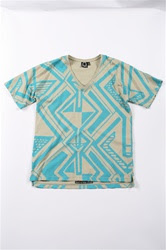
Copy's an OC-based tops-and-bottoms line from a former Perry Ellis/Gotcha guy, who claims a pervasive vintage 90s influence on his mostly limited-edition gear, but in reality, the stuff's so charmingly unfocused that...man, hot dogs make great lunches. Enzyme-washed, super-soft tees are resolutely all over the map, with everything from a simple, thick-striped v-neck, to a digitally printed greyscale moonscape (also available in a hippied-out splash of color), to a face composed of two different eyes, a mouth made of rectangles, and a plus-sign nose -- clearly waiting till it's 18 to get an operation for a greater-than. Other gear's equally rando: a pocketed, plaid button up, a slew of colorful tank tops, and an all-black short-sleeve hoodie, for making all your robberies armed ones.
The new drop's also got Copy's first couple pairs of jeans, one a fairly straight-forward five-pocket affair, the other with extra zippers at the hip, because no matter how ADD a man is, he's always able to buckle down and concentrate on one thing -- facilitating people getting into his pants.
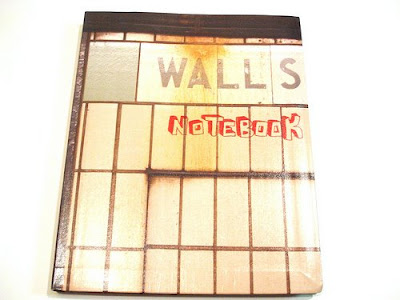
Check out this creative new book a collection with images of clean prospective walls to tag, graffiti and write up on. We guess it’s a safer, less vandalizing way to write your thoughts and design expressions.
Straight out of the Lower East Side of NYC. I always have had great visions in my head and sketched on paper but had never implemented them so I figured why not share it with the world via 100% personalized, limited edition t-shirts brought forward on the softest, most luxurious cotton available. There has not been in the past, is not at this time, and never will be another product available comparable to this. The name and the vision came from the idea that everything of vibrant color, culture and life could be associated with being DIPT NYC. Think ice cream, kotton kandy, blazing summer colors, gumballs, candy, and most importantly personality and life. The pillars of DIPT NYC are originality and individuality. Do what ya like and do what ya feel? Be yourself. Who cares what anyone else thinks! Do you and let me do me! This is the inspiration and life I live: music, film, passion, art, design, diversity, culture and everyday people. DIPT NYC is not to be defined to a single defined market, demographic or race. If you like it, cop it and rock it with respect. My vision is that DIPT NYC will meld all races and cultures together in harmony to bring forth an undeniable revolution in the streets. With this being said I present DIPT NYC:
"A REVOLUTION OF PERSONAL EXPRESSION" Stay Frosty and DIPT NYC!





 Posts
Posts


